Monitor Internet
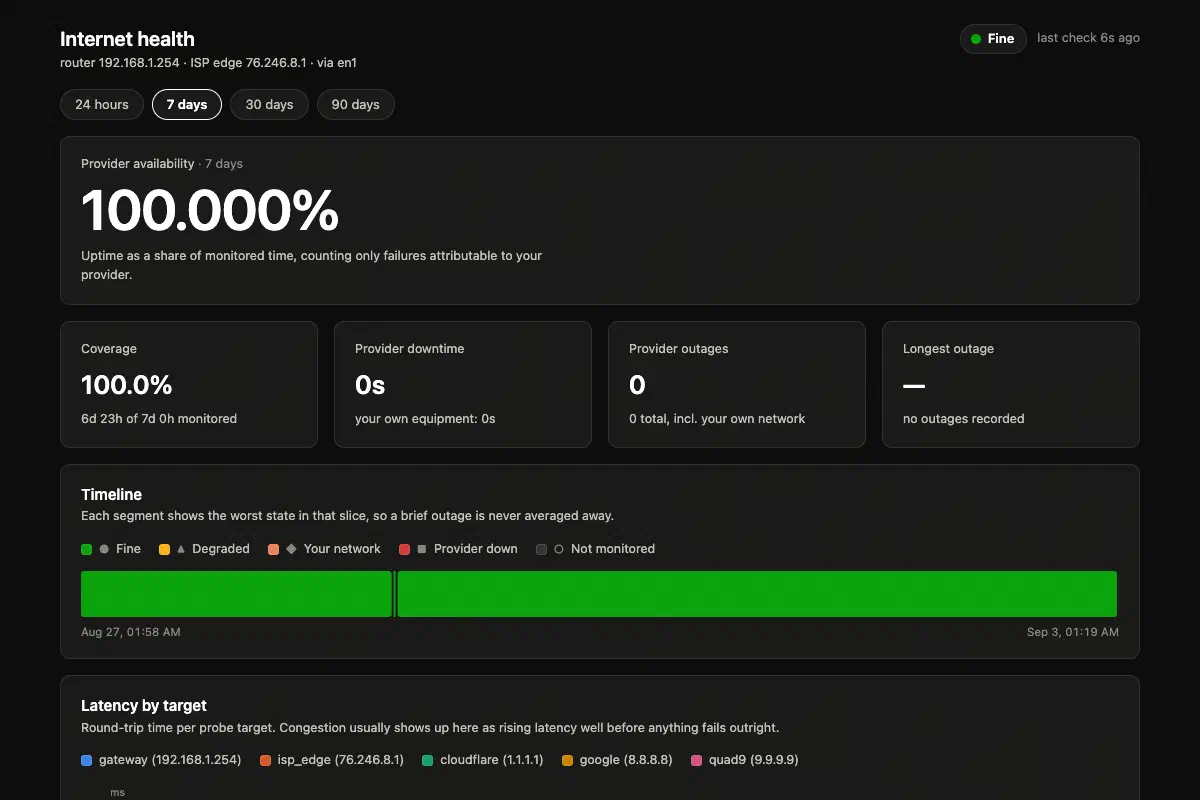
Every time my internet acted up, the script with customer support was always the same: restart the router, check the cables, and assume the fault was inside my own house. I was dealing with intermittent connectivity drops, and I wanted indisputable proof before calling to complain or deciding to switch providers. A simple loop pinging 8.8.8.8 wasn’t going to cut it — when ping fails, it can’t tell you whether your Wi-Fi glitched, your router crashed, or the provider’s line actually went down.
To get honest numbers, the tool splits every probe cycle into three distinct tiers: the local gateway, the ISP’s first public edge hop, and independent internet anchors like Cloudflare, Google, and Quad9. By classifying reachability across all three tiers simultaneously, it definitively attributes every outage to LAN equipment, the ISP’s physical access line, or upstream transit. It pairs that with debouncing and backdating to ignore brief noise, while tracking coverage alongside uptime so machine sleep or reboots never manufacture fake downtime.
The entire Go daemon and CLI was vibe-coded from scratch with Claude Code, and what amazed me most was that Claude Code made all the core architectural and design choices itself. Rather than shelling out to the system ping utility and parsing text output, Claude opted to open unprivileged macOS ICMP datagram sockets directly in Go — running with zero root or sudo privileges and eliminating process jitter. It designed the three-tier attribution taxonomy, structured the SQLite WAL logging, and set up the launchd agents so it runs silently in the background 24/7.